Monthly Archives :

September 2020

Delyramus at the Joaquín Roncal
Delyramus at the Joaquín Roncal 724 1024 delyramus

From October 1 to the next day 15 the works of the workshops product of the European Delyramus project will be exhibited at the Joaquín Roncal exhibition center, located at Calle San Braulio, 5 in Zaragoza.

MIRIAM Method Accessibility to URJC Museums
MIRIAM Method Accessibility to URJC Museums 925 649 delyramus

Universal accessibility and design for all people stands as one of the main means favoring the active participation and equal opportunities of all the diversity of citizens. To do this, it focuses its activity on the search for design solutions so that everyone can use the spaces, products and services in their environment, while participating in the construction of society. Therefore, it is clear to focus attention on universal accessibility which is an effective approach to reverse exclusion and discrimination (both direct and indirect) and increase equal opportunities in a sustainable and positive way.

Within the activities of the Delyramus project we have created this INSTRUMENTAL METHOD FOR COLLECTING INFORMATION ON ACCESSIBILITY IN MUSEUMS: MIRIAM. A methodological tool that allows the collection of essential information to understand the aspects that the Museum must contemplate in order to adequately meet the precise accessibility parameters so that anyone can access and enjoy it, while comparing the data collected with the real situation, allowing to obtain a real-time perspective of the installation.

Check here the accessibility manual

Delyramus workshops carried out by the URJC and the Yehudi Menuhin Spain Foundation at the Virgen de Lourdes Educational and Occupational Center of the Promiva Foundation
Delyramus workshops carried out by the URJC and the Yehudi Menuhin Spain Foundation at the Virgen de Lourdes Educational and Occupational Center of the Promiva Foundation 1024 768 delyramus

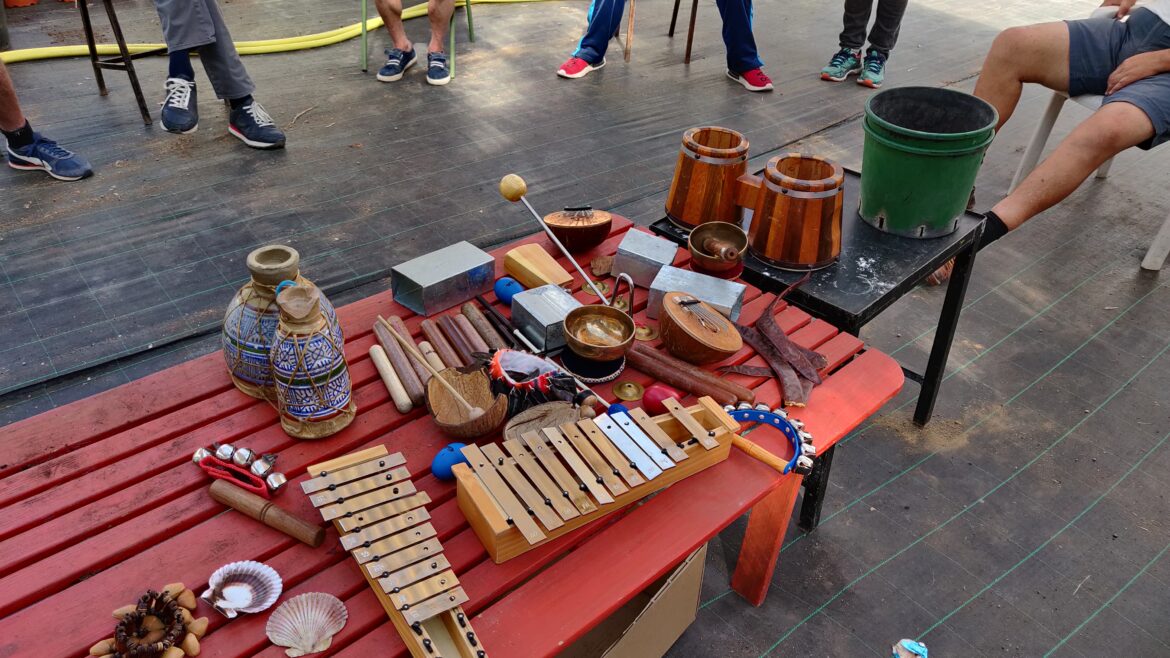
On Friday, July 17, the workshops carried out by the URJC and the Yehudi Menuhin Spain Foundation at the Virgen de Lourdes Educational and Occupational Center of the Promiva Foundation on the occasion of the European Delyramus project ended. The main objective of Delyramus, a work promoted by the Ramón Rey Ardid Foundation in collaboration with the School of Violeros de Zaragoza, is the dissemination of ancient music through the recovery of heritage and traditional techniques of violence, with the participation active of people with disabilities associated with mental illness.

The activities carried out over two days focused on sensory experimentation through songs, rhythms, history and the construction of musical instruments with various recycled materials. Taking as a starting point the historical work of the viola luthiers of the peninsula, the users of the center were able to become musicians and craftsmen throughout the sessions, building their own instruments and then playing them both individually and in groups. The participants of the activity learned traditional songs or songs anchored in the collective memory for being generational hymns, classical music, as well as the creation of fictional instruments through the Lupo System. In this way, the Delyramus project was also linked to the activities carried out previously at the center within the Real Architecture / Real Architecture project.

‘Academic advances on employment, self-employment and entrepreneurship of people with disabilities’
‘Academic advances on employment, self-employment and entrepreneurship of people with disabilities’ 729 1024 delyramus

Qualified employment, self-employment and entrepreneurship of people with disabilities are under debate

  • The Accessible City and the Rey Juan Carlos University publish a scientific academic book addressing basic and strategic issues to favor the labor inclusion of this group
  • The information analyzed will be key in the reconstruction at the level of labor inclusion through the creation of social enterprises from the disability community in the “new normal” post COVID-19


Madrid, Monday June 15, 2020.- Professor Dr. Ricardo Moreno-Rodríguez and the researcher and social entrepreneur with disabilities Antonio Tejada, have been the coordinators and also two of the authors of this book called ‘Academic advances on employment, self-employment and entrepreneurship of people with disabilities’, which is part of the iAccessibility Collection of the Editorial Service of La Ciudad Accesible and which reaches its twentieth volume with this sectorial publication of the Section ‘Employment and Inclusive Entrepreneurship’, another of the lines of Research from the ‘Institutional Research Chair on People with Disabilities, Accessibility and Inclusion (DAI)’ of the Rey Juan Carlos University.

Specifically, this document is the Minutes Book of the communications presented at the ‘V National Congress on qualified employment, self-employment and entrepreneurship of people with disabilities’ held at the Vicálvaro Campus of the Rey Juan Carlos University in Madrid in March 2019 It can be downloaded at the link https://bit.ly/3038jSt and consists of 124 pages. It gives continuity to the book ‘Inclusion, entrepreneurship and employment of people with disabilities. Update and proposals’ published in 2017. The work is inserted within the activities that the group of URJC professors carry out, in addition, in the DELYRAMUS project: Developing Audiences: Music, Luthiers and Mental Health (602109-CREA-1 -2018-1-ES-CULT-COOP1) funded by the European Commission within the call Creative Europe – Culture Sub-program (2014-2020) – ‘Support for European Cooperation Projects 2018’ – ‘Smaller scale cooperation projects’, ( category 1) – Call for proposals EACEA 32/2017

In the words of Ricardo Moreno-Rodríguez himself, “this work is the continuation of the line of work started during our career as a management team of the ‘Konecta-URJC Foundation Research Chair for the Promotion of Entrepreneurship of People with Disabilities’, through which there was a strong boost to the entrepreneurial career of almost 200 people with disabilities. It is the reflection of the congress that we organized last year, through which it was intended to directly address the main problems and limitations found in access to employment, as well as the strengths and opportunities available, placing special emphasis on access to ordinary employment and qualified, for which we have the direct participation of Spanish Universities and their areas of attention to students with disabilities ”.

‘Academic advances on employment, self-employment and entrepreneurship of people with disabilities’ was going to be presented in May at the Rey Juan Carlos University of Madrid, but due to the State of Alarm and suppression of university face-to-face classes, it was decided to make the presentation online so as not to delay the dissemination of this knowledge, which is key and strategic when it comes to addressing the post-COVID-19 economic and social reconstruction both in Spain and in the rest of the world. In fact, this book strengthens a research line of the Diversia Group where several researchers involved in the inclusion of people with disabilities and accessibility participate.

In the words of Antonio Tejada, promoter of the movement of ‘Entrepreneurs with Disabilities’ in Spain and Latin America and founder of The Accessible City, “in the reconstruction after the crisis generated by the pandemic as a result of COVID-19, we must not leave anyone behind and we must understand it as a unique opportunity to do things in a truly inclusive way. Therefore, the work carried out in this book is very important to take it into account in the imminent economic, health and social reconstruction by SARS-CoV-2. These variables and realities presented and analyzed here should be considered as a useful and essential work tool that can be applied in the entrepreneurship of people with disabilities in the new post-Coronavirus normality, as an efficient measure of labor inclusion and to value the talent of people with disabilities ”.

In this way, this academic scientific work where researchers from universities such as Jaén, Burgos, Rey Juan Carlos, Deusto and the Autonomous University of Madrid participate, collects the different contributions in which it is reflected in depth about qualified employment or not, the self-employment and entrepreneurship of people with disabilities, offering an academic vision on the one hand, and a professional vision on the other, trying to describe the current state of the issue, the position of universities in this regard, how the challenge of incorporation into employment is faced after the graduation of students with disabilities, the threats and opportunities for the training of people with disabilities for employment, their involvement with the professional competences addressed in the undergraduate degrees, or the specificities of vocational maturity and the employability of the professional with disabilities.

Thus, in this Book of Minutes it is possible to delve into the ‘Employability and qualified employment strategies for people with disabilities at the University of Jaén’, ‘The labor reality of men and women with autism spectrum disorder in the Spanish context ‘,’ The labor insertion of people with disabilities. Descriptive note through the analysis of collective agreements and corporate corporate responsibility information ‘, the’ Qualified employment of people with disabilities: the role of Universities in the inclusion process, the ‘Employability services and resources for people with disabilities at the UJA ‘or the experience of access to the labor market for people with intellectual disabilities through the’ University Specialist in Urban Green Solutions’.

It also addresses’ The importance of nurseries and incubators in the development of an entrepreneurial project ‘,’ The future of work in Spain ‘,’ The Autonomous Work of people with disabilities in figures: Review of current status data ‘,’ Higher education as a guarantee of success in the job search and in entrepreneurship ‘and the’ Relevant aspects in entrepreneurship of people with disabilities: current situation, factors of interest and results of the Konecta Foundation Research Chair ‘. Among the authors, Ignacio Tremiño, who was the General Director of Disability Support Policies of the Ministry of Health, Social Services and Equality of the Government of Spain and the Royal Board on Disability or Celia Ferrero, Vice President of the National Federation of Associations of Self-Employed Workers (ATA).

It is important to note that the publication has not received any subsidy or sponsorship and has been made completely free of charge by La Ciudad Accesible. It is under a Creative Commons Attribution-Non-Commercial 3.0 Spain (CC BY-NC 3.0 ES) license, so it is allowed to share, copy and redistribute the material in any medium or format, as well as adapt, remix, transform and create from of the material, although never for commercial purposes. The book is an accessible PDF document according to the Adobe Acrobat X Pro program so that voice readers and the visually impaired can access its content.